
Last Words
Thirst, James MacMillan, and The Skull of Adam

Here is the manuscript of a talk I gave as a part of a Lenten speaker series at our church. Each speaker was asked to meditate on one or two of Jesus’ seven last words from the cross.
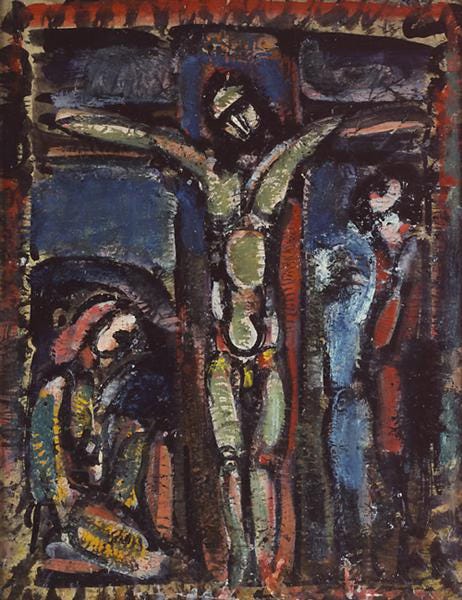
A week ago today, many of us attended an Ash Wednesday service, during which we processed to the front of the church, knelt at the railing and received the sign of the cross, pressed in ash onto our foreheads. “Remember, o man, that dust thou art, and unto dust shalt thou return.”
This year, I brought my two squirmy boys with me. We sat in the front row, so they could see everything happening at the altar. Soon, they saw their father prostrate before the cross alongside two other grown men they both know well. “Why is Daddy lying on the floor?” Weston asked me at one point. “Because…” I began. But what could I say? Because we are dust. Because God died for us? I ended up saying, “Because Daddy loves Jesus, baby.” But I could see his mind was still hard at work. I hadn’t answered his question.
A few minutes later, I steered my two small, beautiful boys up across the naked stone of the sanctuary. They knelt by habit and held up their hands to receive the Eucharist, but instead of feeding them, their father dipped his thumb in ash and marked their tender foreheads with a sign of suffering and death. “Remember, o man, that dust thou art, and unto dust shalt thou return.”
I’m not sure what kind of impression it left on them. Within a few minutes, both boys had wiped the itchy ash from their foreheads. But it left an impression on me. Here was a line of people, all living their complicated, full lives. They were dressed and breathing. And they marched towards death. Ash thou art. There will be a final word from each of the mouths now closed in contemplation, now open with song, now whispering over the heads of children.
Before us, generation on generation has worn a deep groove in the path we now walk. They have knelt at the altar to receive ashes, each generation similarly alive, and then gone. And now, I with my boys, and you, with your friends and family, following them towards ash.
Why do we prostrate before the cross?
***
This year, the Lenten speakers have been tasked with speaking to you about Christ’s final words. There are seven of them in total. Three each in the gospels of Luke and John, and one, the same one, in both Mark and Matthew.
It is sombering to think how much silence must have surrounded each of these utterances. I read them so quickly, hardly fifteen seconds go by between “Woman, behold your son” and “It is finished.” But he hung on the tree for six hours. I imagine long, panting silence between each of Christ’s spoken words, the need to speak welling up inside him until they, these words of life, leapt from the mouth of the Word, like final seeds scattered by a dying plant.
There is a part of me that wishes I could offer you silence instead of speech. It wouldn’t be a very good talk, but it might be better for all of us to hear these words as they were spoken, the voice of God shooting forth over a deep silence, piercing it, planting life where none had been.
This evening, we will spend some time together meditating on the first two of Jesus’ final words in the Gospel of John: “Woman, behold your son” and “Behold your mother,” which together count as one word; and then, “I thirst.”
In the Gospel of John, Chapter 19, we read:
…standing by the cross of Jesus were his mother, and his mother’s sister, Mary the wife of Clopas, and Mary Mag′dalene. When Jesus saw his mother, and the disciple whom he loved standing near, he said to his mother, Woman, behold, your son! Then he said to the disciple, Behold, your mother!And from that hour the disciple took her to his own home. After this Jesus, knowing that all was now finished, said (to fulfil the scripture), I thirst. A bowl full of vinegar stood there; so they put a sponge full of the vinegar on hyssop and held it to his mouth. When Jesus had received the vinegar, he said, It is finished; and he bowed his head and gave up his spirit.
The dying words of any man or woman are saturated with potency. It’s thought that a person who knowingly approaches death recapitulates this life in the final moments. If a good life, a life lived in attunement to God’s will, then a good final word, a good death, marked by peace and generosity. If the life has been filled with fear, resentment, and self-centeredness, the final hours will likely reflect that, too. Of course, it doesn’t always work out that way. Unlike Christ, we aren’t in control of death—how it comes or when. Nor are we able to predict who, like the Good Thief, might repent at the 11th hour.
But if final words carry so much weight for us, how much more must that be the case for God?
Woman, behold your son. When Christ calls Mary “Woman,” he uses a word that ties Mary to Eve, the first woman. “Woman,” he calls out in pain, “behold your son.” “Regenerate Eve, Second Eve, behold your son, your child, the church.” Saint Irenaeus in the 2nd century says that “The knot of Eve’s disobedience was untied by the obedience of Mary; what the virgin Eve bound by her unbelief, the Virgin Mary loosened by her faith.” Whereas Eve’s disobedience to God in the garden brought death into the world, Mary’s obedience at the Annunciation brought forth life. Whereas Eve was the mother of death, Mary is the mother of the living.
And so, to John, Jesus says, “Behold your mother.” “Beloved disciple,” he says in other words, “you are my brother. As my brother, honor our mother, the spiritual mother of all who believe in me.”
All this he says while dying. That darkness none of us have known, creeps forward. And in that state, Jesus establishes the church. He pours out not only his life, but the church itself falls from his lips and is planted in the hearts of the disciples who stand at the foot of the cross.
***
After that, the gospel says, Jesus knew that all had been accomplished. Not only was Christ’s earthly ministry complete, but a work that began many thousands of years earlier, the work that the Father began in Genesis, the creation of man, reached its telos or competition in Jesus.
Orthodox theologian, Fr John Behr, points out that in Genesis, God creates almost everything by fiat: “Let here be light; let the earth brings forth, etc.” But he creates Adam differently. “Let us make man in our image and likeness.” Let us make suggests an ongoing process, a process that began with Adam and culminates in Christ, the first truly living human, the finished man, the fullness of life, crucified.
You may already know this, but I was interested to learn that there is an ancient tradition tracing back to the 2nd century, that Christ’s cross stood directly above Adam’s burial site. In fact, to this day, in the Holy Sepulcher, the Chapel of Adam is positioned underneath the site of Christ’s crucifixion. And in many early Christian images of the crucifixion, a white skull, the skull of Adam, is depicted in a black hole underneath the foot of Christ’s cross.
Of Adam’s skull, Saint Basil of Caesarea writes:
[The] sight of the bone of the head, as the flesh fell away on all sides, seemed to be novel to the men of the time and after depositing the skull in that place they named it Place of the Skull. It is probable that Noah, the ancestor of all men, was aware of the burial, so that after the Flood the story was passed on by him. For this reason the Lord having fathomed the source of human death accepted death in the place called Place of the Skull in order that the life of the kingdom of heaven should originate from the same place in which the corruption of men took its origin, and just as death gained its strength in Adam, so it became powerless in the death of Christ.
But Christ did not come only to model the fullness of human life, he came to offer it. In the Gospel of John, we read that Christ knew that all was finished only after he had laid the foundation of his church. It is by means of the church that Christ means to bring all of us half-finished people into the fullness of communion with God, to open the doors, as it were, for all of us, from Adam on, into his mystical body so that we, too, might become truly human.
“Let us make…” says God in Genesis. “It is finished,” says Christ, as his life-giving blood falls into the dirt over Adam’s head.
***
The symbolic reading of scripture reveals the density and power of Christ’s passion. His suffering and death ripple backwards and forwards in time, pulling all things to the foot of the cross. This is the great, eternal work Jesus is accomplishing. The Gospel of John lends itself to this kind of symbolic reading more than any of the other gospels, but Christ’s passion is not only meant to be read symbolically. We are never meant to get too far from the reality of Jesus’ body. In the gospel of John, we toggle back and forth between the cosmic implications of Jesus’ passion and the bleak, isolated moment-in-time of his anguish.
Now we come to pain.
***
There have been only a few times in my life when a physical need has dominated my entire field of vision. In basic training, the need for sleep was so great that I used to stand in formation and look longingly at the frozen ground. If only they would let me lie down for a minute, I would think. I would have slept with my face pressed to ice.
I’m sure we’ve all experienced fleeting moments of need, like this: hunger, thirst, exhaustion. But in 21st century America, most of us don’t have to face discomfort for long. There is water everywhere and food. In fact, we’ve all been sold the idea that discomfort is the last enemy of mankind, the thing that at all costs should be abolished. And so, it’s difficult to enlarge my limited experience of thirst to enter into his.
When did he last drink? I can’t imagine water or wine being offered when the high priests questioned him in the dark predawn. Or when the Roman soldiers beat and tortured him later that morning. Or when he carried the 125-pound crossbeam through the streets of Jerusalem. Or when he fell under its weight. By that point, I imagine his thirst would have grown to a mind-numbing panic. Not that he was panicked, but that any human body under that much strain would be ringing neurological alarm bells with a mounting sense of urgency—a shrill, internal cry for rest, for water, for an end of pain.
But it isn’t just my lack of familiarity with thirst that makes this moment difficult. It’s also that it’s him, our God, our beautiful, blameless, human Lord. Our King. The Great Physician of our souls and bodies. The Light of the world. The one whose presence I have felt and still feel as the most real, most piercing joy of my life. When I reach this line, my eyes slide off it like butter off Teflon. Christ’s thirst on the cross is too naked, too human, too horrible to think. It takes a terrible amount of effort to keep my mind on his suffering. I do not want to think about it. I don’t want that pain.
One way around that instinctive slipperiness is to find other ways into the scene. Perhaps you are like me and distance yourself from Christ’s passion by sliding past the details of his suffering. Or, perhaps it’s a story you’ve heard so many times it’s lost some of it’s power. For people like us, there are ways of telling the story that dampen the busy, self-defending mind. Music, visual art, drama. But perhaps music most of all.
Now, I’d like to play one such piece of music for you. You might have heard it before. In 1993, the great Scottish composer, Sir James MacMillan, wrote a cantata titled, “The Seven Last Words from the Cross,” commissioned by the BBC. It aired in seven parts during Holy Week in 1994.
What I’m going to play for you today is the 5th movement, titled “I thirst.” You will hear the words “I thirst” repeated throughout and then a passage from the Good Friday Reproaches chanted and whispered in the background: “I gave you to drink of life-giving water from the rock: and you gave me to drink of gall and vinegar.”
I encourage you to quiet your mind, as though you were about to pray. Then, call up the scene of Christ’s crucifixion. In my mind’s eye, I am close to his face. His breathing is labored, and his eyes are closed. I see his hand, nailed and bound. It is the hand of a living man, whose fingertips are calloused, rounded, purpled. He breathes the same air we breath…
After hearing this song for the first time, I wept without understanding why. Now, I’ve heard it many times, and it still moves me. I think it’s the only piece of music I’ve ever heard that takes me into the experience of Christ’s suffering, into, not the perspective of his disciples or onlookers, but the pitch and fever of Christ’s own agony.
In this piece, MacMillan creates a language of bottomless thirst. A thirst that rises up from the beginning of all time. It is a human thirst but not only human. It is also the thirst of God, the pointed tip of his need, his desire for all mankind, for his creation.
In the background, I cannot also help but hear a more familiar sound. It is the sound a mother’s heart might make when she learns her child is dying or dead. The sound of a need and wail and refusal of death so absolute, nothing else exists for her.
We are the children Christ cannot bear to lose. We are the ones he thirsts after. He is like a mother who would throw herself in front of a bus to save her child, but Christ’s anguish and his love (the two are inseparable) are also divine anguish and divine love.
When Christ says “I thirst,” he sums up the great groaning of creation and the counter groaning of its maker. His is a thirst unlike any other—a total thirst. You and I will never thirst this way. It is the thirst of God’s people wandering in the desert and Jesus’ thirst for the salvation of the Samaritan woman at the well. The thirst of those at the Wedding in Cana and the thirst of the repentant thief, who calls out “Lord, remember me in thy kingdom.” It contains, finally, the thirst God has suffered since the fall—the thirst of a Father for his prodigal son, who is lost and dead.
Christ, the prefect man, the only truly human man, establishes his church at the foot of this need—a need, which also goes by the name of love. And so, the church grows and dwindles and grows over centuries, and so we sit in our pews and kneel before the crucified Lord. And every Ash Wednesday, we walk in solemn lines to receive the sign of the cross in ash. And we remember our parched, dry bones, the waterless desert, the thirst we try to quench by a million forms of substitution for the one who came to give us Living Water.
On the cross, Christ opens the door to the only feast that will satisfy his desire and ours. He extinguishes the flaming swords at the gate of Eden. He unhooks the chains of death. God swallows gall. He swallows the nothing that the world offered him. He swallows death and pain and thirst itself to be reunited with us in this, his present and living body.
As always! Enjoyed. Wish I had been there to hear it in person!💕
So beautiful, Kathleen. Thank you for sharing.